Tag Archives: Cygnus

CNYO Observers Log: International Observe The Moon Night At Westhill School District, 12 October 2013

Greetings fellow astrophiles!

Larry Slosberg and Ryan Goodson took their New Moon Telescopes on the road to the Westhill School District for the October 12th International Observe The Moon Night (IOMN, facebook, twitter). With a fistful of our A Guide For Lunar Observing brochures in tow, both report that the near-or-exceeding 100 attendees were full of great questions and enjoyed close-up views of our nearest natural satellite.

CNYO was delighted to be a part of this local IOMN activity and strongly encourage other schools and local groups to do the same. The Moon is the easiest observing target we have, good at all magnifications (including no magnification) and all times of year. It has been a test for physical theories, the guide for calendars throughout human history, unwitting recipient of meteor impacts (still!) that might have made random Tuesdays quite hectic on Earth, muse of artists and musicians alike, and all the light needed for many a midnight hike. If you missed the “official” IOMN session, grab a pair of binos soon and give the Moon a gander!

Below are a collection of images from Larry Slosberg’s observing station (and one great image of the Moon), courtesy of Michelle Marzynski. Click on any image for the full-size version.

2013september27_iomn_1_small
2013september27_iomn_2_small
 
2013september27_iomn_3_small
2013september27_iomn_4_small
 
2013september27_iomn_5_small
2013september27_iomn_6_small
 
2013september27_iomn_7_small
2013september27_iomn_8_small
 

While Larry kept the festivities mostly Moon-centric at his scope, Ryan reports having put many of the best objects in the mid-autumn night sky on full display, including The Andromeda Galaxy (M31), the globular cluster M13 in Hercules, the double stars Albireo (a colored pair in Cygnus) and Mizar/Alcor (a double that becomes a triple at moderate magnification in Ursa Major), the open cluster M39 (“everyone’s fave it seemed” – L.S.) in Cygnus, and finally the Ring Nebula (M57) and the Double-Double in Lyra.

For myself, I celebrated IOMN early from the comfort of a window seat at 36,000 ft. With luck, I hope to be on the ground and running yet another scope for next year’s IOMN session!

2013september27_iomn_9

CNYO Observing Log: Baltimore Woods, 27 September 2013

Greetings fellow astrophiles!

The September 27th Baltimore Woods session was notable for several reasons. On the down side, my drive to Marcellus through Fairmount was delayed when a minivan with far too many large dogs in it had one of its automatic windows dropped down to the delight of an ejected dog that bounced off my driver side door (my non-astro thought for the day – if your pets are your children, please use the child safety options built into your very modern vehicle!). On the up side, for the first time since March, a Baltimore Woods session started at 7 p.m. The skies were dark enough to begin seeing the brightest stars with ease and cold enough to freeze out the many bugs that frequent the BW Nature Center.

Attending scopes included Bob Piekiel‘s massive 16″ Meade GOTO (with some included heavy lifting by the two of us to get it set up and torn down), Larry Slosberg’s 12″ New Moon Telescope, and my 12.5″ NMT Dob (herein referred to as “Ruby”). A fourth scope appeared early in the evening with the first attending family, but ended up not getting too much use. Despite being a bit worse for wear, their “retail store” Stratus 60mm refractor scope surprised the owners (and kids) with a good view of a distant cellular tower and a fuzzy but noticeably “half-moon cookie” Venus (whatever description works is fine with me).

2013september27_bw_bobstratus

Bob inspecting the Stratus 60mm.

The final size (25ish) of the crowd (and the number of first-time attendees) dictated the observables for the evening, with all of us sticking mostly to bright, easily identifiable objects. As for our local neighborhood, the good news was that more than half of the planets were out for the evening (counting the views of Earth). The bad news was that Venus and Saturn set early (both due to the time and the high trees along the Western horizon), leaving the very distant Uranus and Neptune as targets for later-night observers.

As has been my standard procedure, I picked one object from my standard list of “kinds of” objects so those at my scope would be sure to get a sampling of the types of objects we amateur astronomers look forward to looking at. My list included:

* (Hopefully) One Planet – From my (scope’s) vantage point, Venus and Saturn were impossible catches behind large trees. Neptune and Uranus were, for the entire viewing session, nestled within the glow of Marcellus (and Syracuse beyond), so I didn’t even bother attempting to find them. Bob, however, had at his disposal a massive GOTO, so the gathered crowd was able to take in at least one of the two distant planets (making them part of the way-less-than-1% of the entire planet who can claim the same).

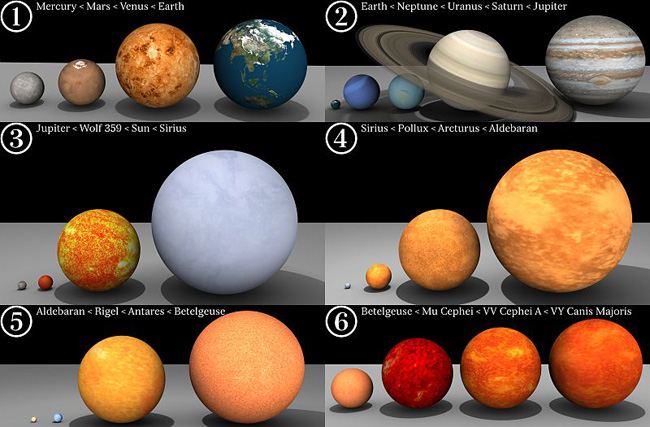
* One Star – At Bob’s request, I gave special attention to Herschel’s Garnet Star (mu Cephei) in Cepheus. One of the real benefits of magnification through good optics (or long-exposure photography) is the appearance of color in many stars that are otherwise just too slightly colored to be noticeable to Naked Eye observers. While the different colors of the binary star Albireo are generally obvious to most people, the Garnet Star jumped out to everyone through every eyepiece as a very orange star. This red supergiant, affectionately known to some as Erakis, is BIG. Those who have seen the image below in one of our CNYO library lectures…
2013september27_bw_starsizes

The scale of familiar objects in our vicinity (click for the wikipedia version).

Will recognize Mu Cephei as the third star from right (in the “Big Block” 6) in the bottom of the image. Our own Sun peters out in Block 3. If a super race of aliens were to swap out our Sun for the Garnet Star, the outer edge of its plasma would engulf Jupiter and either engulf or roast Saturn. Big. Not only big, but old to boot. Mu Cephei is what is known as a “carbon star,” one that has nearly exhausted its helium (which is produced from all the fusion of hydrogen, which it then exhausted quite some time ago) and is now producing carbon in the star’s core. The near-exhaustion of the star’s fuel means that it’s likely only a few million years from going supernova (somewhere between a finger snap and ringing wine glass in cosmic terms) and is currently identified as a variable star for its subtle and erratically changing brightness.
2013september27_bw_cepheus

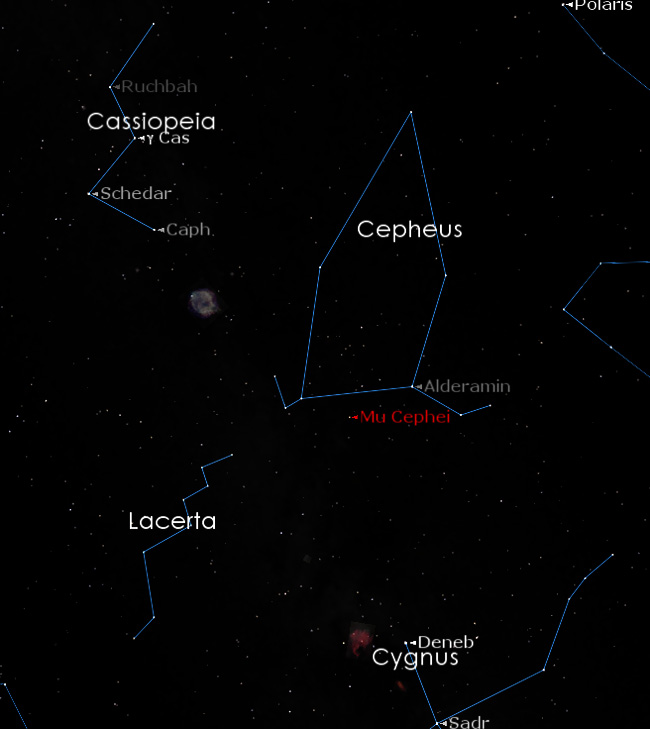
Mu Cephei, Cepheus, and surrounding constellations.

As you scour Cepheus some evening, do take the Garnet Star in. If you’re scanning randomly along the bottom of the barn, you can’t miss it!

* One Binary – Albireo in Cygnus remains an easy favorite. Everyone saw Albireo A as slightly orange or yellow, while Albireo B appeared as slightly to “clearly” blue (clearly a demonstration of the importance of dark adaption and cone sensitivity in the retina). One point of interest is that we’re not entirely sure of Albireo is an optical binary (the two just appear close, but one is much farther away than the other as projected onto our two-dimensional sheet of the Night Sky) or a gravitationally-bound binary pair. If gravitationally-bound, the two are likely far from one another, with the orbital dance occurring over 100,000 or more years.

* One Open Cluster – The Double Cluster (Caldwell 14) in Perseus

* One Globular Cluster – The ever-obvious M13 in Hercules

* One Nebula – The Veil Nebula in Cygnus – typically, this would be considered one of the less-easy objects for a new observer to make out. Through an OII filter, however, the wispy-ness jumps out and new observers, with a little patience, can even see the curvature of each fragment well enough to know where the Veil must be radiating from.

* One Galaxy – M31, The Andromeda Galaxy in Andromeda (and M32 and M110), which were easy for all to spot with a little scope nudging.

As has become the norm recently, I packed up Ruby around 9:30 p.m. and pulled out the Canon T3i and tripod for an extended session of scope-less astrophotography. Three highlights include a very discernible Milky Way, complete with Great Rift, from opposite the direction of Marcellus…

2013september27_bw_mw_1_small

The Milky Way (plus one bright plane and one dim satellite). Click for a larger version.

A dimmer part of the Milky Way that seemed to radiate from (and be washed out by) Marcellus…

2013september27_bw_mw_2_small

The Milky Way and Marcellus (plus a dim plane (dashed line) and dim satellite). Click for a larger version.

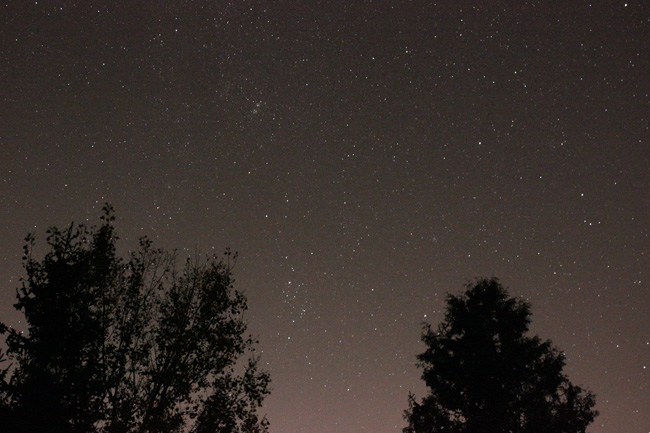
And a quite decent view of the varied objects in the vicinity of the constellation Perseus (in the pocket between the two trees and closer to the left tree), including the components of the Double Cluster, NGC 884 and 869 (the fuzzy splotches at the base of the small necklace – 1/3 over from the left edge and 1/4 down the image).
2013september27_bw_perseus_full

Perseus, NGC 884, and NGC 869. Click for a larger version.

I packed it in around 10:00 p.m. in great anticipation! Within the glow of Marcellus lay the Pleiades (M45) and just a hint of its closer cousin the Hyades in the head of Taurus the Bull. These objects have likely served as markers for many millennia that the clear, dark, steady, and uncomfortably cold night skies of winter approach.

A Small Mob For A Big Event – Quick Summary Of The New Nova Party For PNVJ20233073+2046041

CNYO’s first official “Scope Mob” and New Nova Party was composed of Larry Slosberg, Dan Williams, and myself. After only 50 minutes of observing (and enjoying a moonlit sky still clear enough to see plenty of detail), I am pleased to report that we:

(1) found the nova easily enough in binoculars and scopes

(2) saw three bright Perseids between us (it’s still going!)

(3) caught the ISS and many, many satellites

(4) as an added bonus – we caught DAICHI (ALOS) that flared four times as it went from South to North (very nice addition!). To see what gave it that flaring power, I refer you to the image below (and its very hefty solar array):

2013august15_jaxa-alos-daichi-satellite

DAICHI (ALOS) – See space.com for details.

(5) found the Moon yet again (very pleasant as always, with some nice brightening of high-elevation objects beyond the terminator)

(6) found a great little spot for hosting future impromptu darker sky observing sessions

For those wanting to check out the nova themselves in the next few days, I am pleased to report that it is presently Naked Eye (so is markedly brighter than it was even last night – 5.0 and brightening by all reports). For those interested in the search, I provide unlabeled and labeled images below. The key is to find the brighter Delphinus (look below Cygnus for the medium-bright diamond shape), then find Sagitta above and to the right (looks like a dim arrow). Naked Eye, you will see a star above Delphinus’ head, then another one between this bright star and the arrow tip of Sagitta. That “other” star is the nova, likely set to be even brighter tomorrow (with a closer Moon but still clear predicted skies). If you’re using 7x to 25x binoculars, you will see a small cluster of stars to the lower-left of the nova – which I’ve connected in the form of a Rockette for what may or may not be an obvious reason.

2013august15_nova_unmarked

Unmarked image (Canon T3i, 13 sec. exposure, ISO 1600). Click for a larger view.

2013august15_nova_marked

Marked image (Canon T3i, 13 sec. exposure, ISO 1600). Click for a larger view.

But it’s a relatively easy find once you have Delphinus and Sagitta figured out. There are only two other bright starts in the vicinity!

CNYO Observing Log: Star Search! At Green Lakes State Park, 26 July 2013

2013august13_greenlakes_3

The gathered crowd at Green Lakes.

July 26th saw the yearly return of Bob Piekiel, his 11″ Meade SCT, and 25x125mm Vixen Binoculars to Green Lakes State Park for his yearly “Star Search” observing session (original post HERE). Also in attendance were Ryan Goodson (representing CNYO and New Moon Telescopes with his fantastic 16″ Dobsonian) and myself (with “Ruby,” my equally fantastic 12.5″ NMT Dobsonian). I’ve been to Green Lakes many, many times over the last few decades, but I’ve never “seen” the place after sunset. I am pleased to report that CNY has an excellent piece of flat, maintained ground, low horizon, and reasonably dark sky just 20 minutes from downtown Syracuse – a place that I hope sees much more observing activity in the future.

2013august13_greenlakes_1

Local flora and fauna in the parking lot.

Ryan and I arrived around 8:00 p.m. to the sight of 40-or-so kids and adults huddled around a well-spaced campfire that doubled as a s’mores factory. Also in attendance were two caffeinated dogs and a few deer in the parking lot. The location of the session was just near the camping ground, with the parking lot and flat grounds centered in the google map below (a “right” and a “left,” a little meandering, and you’re there).


View Larger Map

The session started just after sunset with the identification of Venus in the Western sky as it began to settle behind trees. This served as an opportunity for everyone to see how the scopes work (and have them demonstrated so everyone knew where the eyepiece was later), to see the appearance of phase in this inferior planet (not to belittle Venus or Mercury – “inferior” refers to them being closer to the Sun than Earth. All other planets are “superior” to Earth in this respect, and we are one of Mars‘ inferior planets), and to see just what a thick, damp atmosphere does to bright pinpoints of light. In this case, the atmosphere acts like a prism, splitting the light from Venus slightly into subtle reds and blues on opposite sides the planet. Not a pretty view for an astronomer looking for sharp detail, but an excellent lesson in optics nonetheless.

2013august13_greenlakes_2

Bob (right) on Venus, Ryan (middle) discussing advanced optics design.

With the dogs corralled into nearby cars and Bob unable to shout louder than mezzo-piano for the session, I gave a brief introductory greeting around 9:00 p.m. that stressed the few important points we wish everyone going into a public observing session would know beforehand (but are happy to explain prior to observing through the scopes). These same points appear on one of the fold-out plaques we bring to each session:

1. If You Don’t See Something, Say Something!

During Mars’ 2003 closest-approach at Darling Hill Observatory, people waited in line for nearly an hour to catch a glimpse of Mars they wouldn’t have from Earth’s surface for quite some time to come. One woman looked quickly, then came down a bit put off by the poor sight she had waited so long to see. I snuck back up the ladder to find Mars nowhere in sight – the scope had moved off of Mars by some unseen event (it was dark after all). We put Mars back in, found the woman walking out of the observatory room, and escorted her right back up the ladder to a sight that was definitely worth the wait. Sidewalk astronomers are there for YOU, so ask questions, ask for clarification, make comments about the view, whatever it takes to make sure you don’t inadvertently miss a great sight.

2. Bright Lights = Bad Lights

Smart phones are the new bane of amateur astronomers, having taken over the role white-light flashlights once held. The first thing we tell people (and the first thing we re-tell late arrivals) is that the dark adaption of your vision is a sensitive and time-consuming thing. 15 to 20 minutes are required for your eyes to adjust to the dark enough to see more detail in the Night Sky (and any detail on the ground). One camera flash, one answered phone, one slip of the flashlight can set a whole group’s dark adaption back to square one. Whether by intention or accident, it is a disservice to other observers to set their observing back, so we always ask that people take extra care to spare attendees from bright lights. If your flashlight has a red mode, use it(!), as our vision is largely insensitive to red light (meaning no real dark re-adaption is necessary).

3. Dobsonians Move In A Stiff Breeze

One thing I’ve noticed among some young (younger than 10, that is) observers is a tendency to want to bring the view to them – which they do by dragging the eyepiece to their eye instead of walking up to see what the scope is focused on. We love the enthusiasm, but we don’t know what they’re seeing after they’re done moving! Because Dobsonians are designed to move very smoothly in all directions, we tell people that the best way to observe is to:

“Put your hands behind your back and walk up to the eyepiece.”

I see kids and adults do this after I mention it – and it works great.

4. Don’t Be Afraid Of The Eyepiece!

A final tendency I see among some new observers (especially with glasses) is to find a comfortable spot 2 or 3 inches from the eyepiece. And some young kids have it even worse as their parents try to hold their kid’s head near the eyepiece. No good! When I see someone doing either, I take over the observing, hand them my red flashlight, and show them just how to get that excellent view. Everyone’s done something new that they clearly didn’t know the procedure for. A bit of demonstration goes a long way (especially when you see the same person back in line for a new object and they walk up to the eyepiece – hands behind their back – like a pro).

An Education-First Session

The session itself ran quite smoothly for several hours, with Bob, Ryan, and I mostly sticking to easy-to-see objects. Another important aspect of a sidewalk astronomy or public viewing session is not to tax the new observer’s imagination by asking them to focus on dim, faint objects that might be totally invisible to someone who doesn’t know how averted vision works. Like an opening band trying to get their best material out in 30 minutes before the headliner, a session for new observers should emphasize big, bright objects where what you describe to them is obvious after a few seconds’ time. If you want to introduce new observers to a taste of everything, I recommend finding the best of each of the objects below to have at-the-ready and ready to describe (I include my choices with each for the Green Lakes session):

* (Hopefully) One Planet – Venus and Saturn
* One Star – Vega in Lyra
* One Binary – Albireo in Cygnus
* One Open Cluster – The Double Cluster (Caldwell 14) in Perseus
* One Globular Cluster – M13 in Hercules
* One Nebula – M57, The Ring Nebula in a href=”https://en.wikipedia.org/wiki/Lyra”>Lyra
* One Galaxy – M31, The Andromeda Galaxy in Andromeda (but I started with M51, the Whirlpool Galaxy in Canes Venatici just off the bowl of the Big Dipper, to stall until Andromeda cleared the horizon)

2013august13_greenlakes_4

A 15-second exposure of the Big Dipper from the grounds.

I was fortunate to have as my last set of public observers two near-teenagers who were attentive enough to my description of Andromeda and the mechanics of Dobsonian motion that I let them take Ruby’s reigns to find M110, a satellite galaxy just outside of the field of view of M31 and M32 in my scope. After both Bob and the crowd took off for the evening, Ryan and I spent another 30 minutes or so observing (pulling out the Veil Nebula in Cygnus – and still near Fayetteville’s lights!), where we decided that Green Lakes is an excellent, reasonably dark sky location in Syracuse’s direct suburbs – a location we would very much like to make a more regular CNYO observing hotspot.

CNYO Observing Log: Baltimore Woods, 13 July 2013

One month from the peak of the Perseid Meteor Shower, Bob Piekiel’s monthly Baltimore Woods session this past July 13th was a study in summertime CNY observing – that is, a study in patience, persistence, and bug spray.

2013august1_scopes

Caption: Scopes and observers at the ready.

The evening started with an expectation of partly-cloudy skies according to all forecasts. The setup of of Bob’s 16″ Meade SCT, 25×125 Vixen binoculars, Larry Slosberg’s 12″ New Moon Telescope Dobsonian, and my 12.5″ NMT Dob went slowly as we watched the clouds move fast and move in. What might have been an early observing crowd at BW turned out to be an evening Frog Walk program that had the attendees hopping into the distance from the parking lot.

2013august1_bob_elaine

Caption: Elaine, Bob, and a 16″ Meade SCT.

Scope setup and cloud cover were complete by 8:45 p.m., leaving a group of eight of us to strain to see Vega, Deneb, Altair, and Arcturus (the four brightest stars in our sky this session). Their appearance at all produced the call of their individual names for well over an hour. We were lucky enough to catch a few early glimpses of Saturn and the Moon, but even they were no match for cloud formations approaching from the West. While no one complained loudly about the mosquitoes in the air, no one appreciated their presence either. One of the benefits of a non-DEET (or, at least, more natural) bug spray is that, with a spray and rubbing-in around your head and neck (that you are more hesitant to do with the DEET variety), you can stare into an eyepiece unencumbered by the ever-louder buzzes in your ear.

2013august1_author_and_scopes

Caption: The author waiting impatiently for clear skies (photo by Larry Slosberg).

With the hopes of later clearer skies (and because the scopes were set up anyway), the group engaged in the time-old tradition of assorted conversations under an overcast nighttime sky while waiting for clearings between clouds.

With 20 minutes to go in the “official” BW session, dark patches finally began to appear at our zenith. Within 10 minutes, these small patches had grown into large spans of dark sky, from which observing began in earnest at 10:50 p.m.

2013august1_enhanced_south

Caption: A view of the southern sky (featuring Sagittarius and Scorpius).

The official session lasted another hour or so and included a few Iridium Flares and one pair of unwanted car headlights directly in our path (if you see a scope in the middle of nowhere, PLEASE dim your lights).

2013august1_car

Caption: A very close double – car headlights raining on our session.

My observing list included Albireo (the head of Cygnus the Swan and one of the great double stars in the Night Sky), Alcor and Mizar in the handle of the Big Dipper (in the tail of Ursa Major), the great globular cluster M13 in Hercules, the “Double-Double” binary star pair in Lyra (Epsilon1a and Epsilon2a Lyrea, making up the handle of the lyre with Vega), The Ring Nebula (M57) in Lyra, the Veil Nebula (a supernova remnant quite obvious in an O III filter) in Cygnus, and M5 (which I think is a slightly crisper globular cluster than M13) in Serpens. In the search for M5, the skies were dark enough that NGC 5921 in Serpens (the half of Serpens known as Serpens Caput, to be specific) became ever-so-slightly prominent. This galaxy, dim and featureless but still bright enough to notice in a scan of the skies around M5, is shown in Hubble images to be a fantastic barred spiral galaxy.

2013august1_ngc5921

Caption: NGC 5921 (from NASA/Hubble).