Tag Archives: Green Lakes State Park

CNYO Observing Log: Green Lakes State Park, 25 July & 15 August 2014

* Session 1 – 25 July 2014

Exactly 364 days after our last outing past the now-defunct Fayetteville Friendly’s, Bob Piekiel and I hosted another well-attended session in the large open (frisbee) field of Green Lakes State Park on July 25th. This Friday evening saw reasonably warm and dewy conditions and no small amount of bug spray. The generally young crowd (2/3’s in the mid-teen or younger) was treated to Bob and mine’s usual post-dusk schtick, early sights of Saturn and Vega, and then a small host of other celestial objects as the night grew darker (after many of the youngest were dragged away by schedule-conscious adults).

2014august12_greenlakes_july25_small

Bob Piekiel inspecting the dusk skies during setup.

After setup, the race was on for one of us to find Saturn to make sure everyone had seen at least one planet before leaving. After a lucky run of star finding (Vega and Arcturus) to align his Celestron NexStar 11, Bob had a long planetary line behind him, leaving me to start the evening with my New Moon Telescopes 12.5″ Dob on Vega (giving my post-Saturn line a glimpse of increasing numbers of stars around Vega as it darkened). By the end of the Vega line, Saturn was obvious to all and Mars was just between widely-spaced branches, allowing us to fill in the planet views before 1/2 the attendees (and all the youngest observers) left just after 9:00 p.m.

The rest of the evening was the usual free-for-all. While the sky still wasn’t nearly dark enough for dedicated observing at 10:00 p.m., we were fortunate to have a remaining group with both great interest in astronomical phenomena and vivid imaginations to fill in the perceptual gaps left by distant Fayetteville lights and our own early event timing. The discussions around the scope were as well received as the objects themselves.

As you might expect, having a session almost exactly 1 year apart means that the “pick hits” of last year were very similar to the “pick hits” of this year. The only real difference was the swapping of one swiftly-moving planet (Venus) with another (Mars). Saturn, in that one year block, has slid only slightly from Virgo last year to Libra this year. As for my usual policy of presenting at least one from the list of standard types of objects at each session, my observing and lecture list was as follows:

* (Hopefully) One Planet – Saturn
* One Star – Vega in Lyra was the obvious choice, giving all an early view of how bright stars shimmer strongly upon magnification (and allowing us to show how the shape of the spiders holding up our secondary mirrors affects our views). At Bob’s request, we also threw in Herschel’s Garnet Star in Cepheus as an example of very strongly-colored stars in the night sky (after showing Albireo to demonstrate the same).
* One Binary – Albireo in Cygnus. I also included epsilon Lyrae in Lyra as it was close to Vega. Alcor and Mizar in Ursa Major are also excellent for testing visual acuity among attendees (and the magnified view gives still more to say about double stars in our neighborhood).
* One Open Cluster – The Double Cluster (Caldwell 14) in Perseus
* One Globular Cluster – M13 in Hercules
* One Nebula – M57, The Ring Nebula in a href=”https://en.wikipedia.org/wiki/Lyra”>Lyra. The use of an inflating balloon to demonstrate how you can see through the middle of a well-inflated balloon but can’t see well through the edges is as clear an explanation of what the Ring Nebula is from our vantage point as any other I can think of.
* One Galaxy – M31, The Andromeda Galaxy in Andromeda. Despite the closeness to the horizon, M32 and M110 were also visible to observers at low magnification.
* Anything Else? – we were treated to several dozen obvious satellites and at least one bright meteor tail before packing up.

* Session 2 – 15 August 2014

The week of August 11 – 17 will be remembered as an almost useless one for CNY amateur astronomy. The Perseids were not only washed out by the timing of the Full Moon, but also by the constant overcast conditions (mixed with a few interesting lightning storms). Planned sessions at Baltimore Woods, Beaver Lake Nature Center (rescheduled for August 21st!), and North Sportsman’s Club were all scrubbed.

Given the lousy conditions all week for nighttime observing, I was a bit hesitant to drive out to Bob Piekiel’s August 15th session at Green Lakes State Park (even with one scope, it’s a lot of gear to drag around for a session where it won’t be used). That said, the Clear Sky Clock indicated a potential opening in the 9-ish to 11-ish range and the s’mores weren’t going to eat themselves. The crowd of around 25 (all crowded around a fire pit that smelled of charred marshmallow) were ready to observe and full of questions and fun discussion, so the early views of Saturn, Vega, and Arcturus were enough to keep us all occupied.

Around 9:20 p.m., a small miracle occurred as a massive clearing of the sky swept South/SouthEast, taking with it all of the present clouds in a slow, straight band that eventually gave us views of the entire sky before closing back again around 10:30 p.m. The clear, steady 70 minutes were more than enough to allow us to re-scan last month’s observing list (all little changed since last month!).
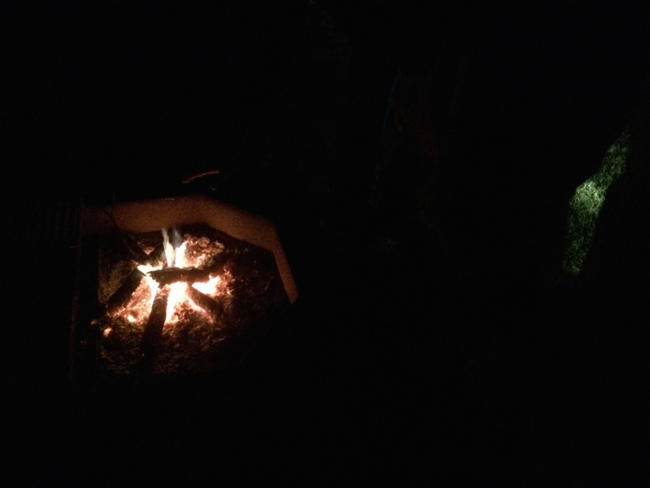
2014august18_greenlakes_fire

Old and new light – the end of the fire pit and inspecting flashlights.

With everyone departing soon after, we were left to take in a bit of the remaining fire in the pit (and our observing attire left to take in that burning wood smell) before giving the grounds one last scan with a bright flashlight before departing. A lousy evening turned into a fantastic (and slightly shortened) night for a Public Viewing Session. Kudos as always to Attilla Danko for his ever prescient Clear Sky Clock!

Event Announcement: Bob Piekiel At Green Lakes State Park – Friday, 25 July 2014

Greetings fellow astrophiles!

The weather currently looks excellent for Friday night, so please join Bob Piekiel and other CNYO members at Green Lakes for a little bit of Summer Sky observing! Saturn and Mars continue to grace our Southern Sky, with Saturn looking particularly well-angled for ring detail this year. Mars and Saturn also serve as the opening act for the wealth of “local” Messier Objects that populate our galactic center beyond the stars of Sagittarius. One could keep their scopes pointed South and not be bored all night!

2013august13_greenlakes_3

The crowd at last year’s Green Lakes event.

Directions to the field are below and the observing will begin with Saturn and Mars as soon as the Sun sets far enough for us to see them. We’ll announce any changes to the event on this page, so check back around 5:00 p.m. Friday for any updates. We hope you can join us!

Highlights From Bob Piekiel’s Green Lakes Solar Observing Session, 8 February 2014

Greetings fellow astrophiles,

A decent-sized group of appropriately-dressed observers braved the mid-winter cold to attend a solar observing session at Green Lakes State Park this past Saturday, February 8th (approx. 1 to 3 p.m.). The event, organized by Baltimore Woods favorite Bob Piekiel, was wing-observered by Ryan Goodson, Larry Slosberg, and Steve Capp. Observers were treated to a reasonably busy solar surface, with the massive sunspot 1967 and the small constellation of sunspots around 1968 just disappearing out of the field of view with the Sun’s rotation (and our revolution), then several smaller sunspots working their way across the Sun’s equator (that said, note the Earth size in the image below. Sunspots 1973 and 1974 are large enough to swallow the Earth whole!).

sunspots_1024_20140208

The Sun on 8 February 2014. Image from NASA/SOHO.

Below is a gallery of images from the event (our first attempt at a CNYO gallery. If you have issues loading images or just don’t like how it works on the site, please let us know) featuring photos by Ryan Goodson and Cindi Farrell. Another session is coming up from 1 to 3 p.m. on February 22 (with the 23rd as the weather alternate) at Baltimore Woods. We hope you can join us for that one as well!


[envira-gallery slug=”2014-green-lakes-solar-session”]

Bob Piekiel Hosts Observing Sessions At Baltimore Woods (And More!) – 2014 Observing Schedule

I’m pleased to have obtained the official schedule for Bob Piekiel’s growing observing and lecture programs for the 2014 season and have added them to the CNYO Calendar. For those who have not had the pleasure of hearing one of his lectures, attending one of his observing sessions, or reading one of his many books on scope optics (or loading the CD containing the massive Celestron: The Early Years), Bob Piekiel is not only an excellent guide but likely the most knowledgeable equipment and operation guru in Central New York.

Notes On Baltimore Woods Sessions:

The Baltimore Woods events calendar is updated monthly. As such, I’ve no direct links to the sessions below. Therefore, as the event date nears, see the official Calendar Page for more information and any updates on the event.

Also…

* Registration for these events are required. Low registration may cause programs to be canceled.
* $5 for members, $15/family; $8 for nonmembers, $25/family.
* To Register By Email: info@baltimorewoods.org
* To Register By Phone: (315) 673-1350

Green Lakes:

* February 8 (Fri.)/9 (Sat. weather alternate), 1-3 p.m.

Solar viewing session at the main office parking lot. See the Green Lakes website for directions.

Baltimore Woods:

* February 21 (Fri.)/22 (Sat. weather alternate), 7-9 p.m.

The giant planet Jupiter will be in prime viewing position all night long, as well as the brilliant winter skies surrounding the constellation Orion. Uranus and Neptune will also be visible early.

* February 22 (Sat.)/23 (Sun. weather alternate), 1-3 p.m.

A solar viewing program, featuring our nearest (and favorite) star! Come and enjoy safe views of the Sun through a variety scopes and several wavelengths.

* March 21 (Fri.)/22 (Sat. weather alternate), 7-9 p.m.

Jupiter will be visible high in the sky for excellent viewing in the evening, then come and bid farewell to the Winter Skies.

Montezuma Wildlife Refuge:

* March 28 (Fri.)/29 (Sat. weather alternate), 7:30-9:30 p.m.

Come and enjoy the late Winter / early Spring skies, featuring views of Jupiter.

Baltimore Woods:

* April 15, VERY Early Tuesday A.M. – Midnight to 2:30 am

Again, assume this starts at 11:59 p.m. on Monday, April 14th and goes through about 2:30 a.m. Tuesday morning. This is the first Lunar Eclipse CNY has had in several years, and it will be visible in its entirety for all in NY State. Watch the Moon get covered by the Earth’s shadow and turn a deep shade of orange or red. Saturn and Mars will be in good viewing positions as well for scope viewing.

Mohawk Valley Astronomical Society:

* May 14 (Wednesday)

Bob Piekiel gives the lecture “Collimating Cassegrains and Two-Mirror Scopes” for our friends in the Mohawk Valley Astronomical Society (MVAS).

Baltimore Woods:

* May 23 (Fri.)/24 (Sat. weather alternate), 8:30-10:30 p.m.

Join Bob Piekiel for a possible Meteor Storm! In the early morning hours of Saturday, May 24, the Earth will pass through the debris field left behind by a small comet known as P/209 LINEAR. Astronomers are predicting that this interaction may result in a brief but intense burst of meteor activity that could range from dozens to hundreds of meteors per hour. Nothing is certain, but many mathematical models are predicting that this could be the most intense meteor shower in more than a decade. Saturn will also be at its biggest for its best viewing of the whole year, plus good views of Jupiter and Mars are to be had. Come and say “hello” to the Spring Skies!

* June 6 (Fri.)/7 (Sat. weather alternate), 8:30-10:30 p.m.

Join Bob Piekiel for an in-between Baltimore Woods sessions during this weekend’s Mars and Moon Conjunction.

Baltimore Woods:

* July 18 (Fri.)/19 (Sat. weather alternate), 8:30-10:30 p.m.

Look into the heart of our Milky Way galaxy to see the finest examples of rich star clusters and gaseous nebulae. Also fantastic views of Mars and Saturn.

Green Lakes:

* July 25 (Fri.)/26 (Sat. weather alternate), 8:30 – 10:30 p.m.

Summer Milky Way, at the Frisbee Golf field.

Baltimore Woods:

* August 12 (Tues.)/13 (Wed. weather alternate), 8:30-11:00 p.m.

The annual Perseid meteor shower, one of the year’s finest, plus Summer Skies and the Milky Way. Look into the heart of our Milky Way galaxy to see the finest examples of rich star clusters and gaseous nebulae. Also fantastic views of Mars and Saturn.

Green Lakes:

* August 15 (Fri.)/16 (Sat. weather alternate), 8:00 – 10:30 p.m.

Summer skies and left-over Perseids.

Baltimore Woods:

* August 16 (Sat.)/17 (Sun. weather alternate), 1:00-3:00 p.m.

Solar observing program

Seneca Meadows:

* August 22 (Fri.)/23 (Sat. weather alternate), 8:30-10:30 p.m.

Summer skies

Clark Reservation State Park:

* August 29 (Fri.)/30 (Sat. weather alternate), 8:00-10:00 p.m.

Baltimore Woods:

* October 8 – EARLY MORNING 4:30 – 6:30 am.

Lunar Eclipse, NO BACKUP DATE.

* Monday, November 17 (backup Tuesday 18th) 8 – 10 p.m.

Leonid meteor shower and hello to fall skies. Also the planets Uranus and Neptune.

* Saturday, December 13 (backup Sunday the 14th) 7 – 9 p.m.

The Geminid meteor shower and hello to winter skies.

CNYO Observing Log: Star Search! At Green Lakes State Park, 26 July 2013

2013august13_greenlakes_3

The gathered crowd at Green Lakes.

July 26th saw the yearly return of Bob Piekiel, his 11″ Meade SCT, and 25x125mm Vixen Binoculars to Green Lakes State Park for his yearly “Star Search” observing session (original post HERE). Also in attendance were Ryan Goodson (representing CNYO and New Moon Telescopes with his fantastic 16″ Dobsonian) and myself (with “Ruby,” my equally fantastic 12.5″ NMT Dobsonian). I’ve been to Green Lakes many, many times over the last few decades, but I’ve never “seen” the place after sunset. I am pleased to report that CNY has an excellent piece of flat, maintained ground, low horizon, and reasonably dark sky just 20 minutes from downtown Syracuse – a place that I hope sees much more observing activity in the future.

2013august13_greenlakes_1

Local flora and fauna in the parking lot.

Ryan and I arrived around 8:00 p.m. to the sight of 40-or-so kids and adults huddled around a well-spaced campfire that doubled as a s’mores factory. Also in attendance were two caffeinated dogs and a few deer in the parking lot. The location of the session was just near the camping ground, with the parking lot and flat grounds centered in the google map below (a “right” and a “left,” a little meandering, and you’re there).


View Larger Map

The session started just after sunset with the identification of Venus in the Western sky as it began to settle behind trees. This served as an opportunity for everyone to see how the scopes work (and have them demonstrated so everyone knew where the eyepiece was later), to see the appearance of phase in this inferior planet (not to belittle Venus or Mercury – “inferior” refers to them being closer to the Sun than Earth. All other planets are “superior” to Earth in this respect, and we are one of Mars‘ inferior planets), and to see just what a thick, damp atmosphere does to bright pinpoints of light. In this case, the atmosphere acts like a prism, splitting the light from Venus slightly into subtle reds and blues on opposite sides the planet. Not a pretty view for an astronomer looking for sharp detail, but an excellent lesson in optics nonetheless.

2013august13_greenlakes_2

Bob (right) on Venus, Ryan (middle) discussing advanced optics design.

With the dogs corralled into nearby cars and Bob unable to shout louder than mezzo-piano for the session, I gave a brief introductory greeting around 9:00 p.m. that stressed the few important points we wish everyone going into a public observing session would know beforehand (but are happy to explain prior to observing through the scopes). These same points appear on one of the fold-out plaques we bring to each session:

1. If You Don’t See Something, Say Something!

During Mars’ 2003 closest-approach at Darling Hill Observatory, people waited in line for nearly an hour to catch a glimpse of Mars they wouldn’t have from Earth’s surface for quite some time to come. One woman looked quickly, then came down a bit put off by the poor sight she had waited so long to see. I snuck back up the ladder to find Mars nowhere in sight – the scope had moved off of Mars by some unseen event (it was dark after all). We put Mars back in, found the woman walking out of the observatory room, and escorted her right back up the ladder to a sight that was definitely worth the wait. Sidewalk astronomers are there for YOU, so ask questions, ask for clarification, make comments about the view, whatever it takes to make sure you don’t inadvertently miss a great sight.

2. Bright Lights = Bad Lights

Smart phones are the new bane of amateur astronomers, having taken over the role white-light flashlights once held. The first thing we tell people (and the first thing we re-tell late arrivals) is that the dark adaption of your vision is a sensitive and time-consuming thing. 15 to 20 minutes are required for your eyes to adjust to the dark enough to see more detail in the Night Sky (and any detail on the ground). One camera flash, one answered phone, one slip of the flashlight can set a whole group’s dark adaption back to square one. Whether by intention or accident, it is a disservice to other observers to set their observing back, so we always ask that people take extra care to spare attendees from bright lights. If your flashlight has a red mode, use it(!), as our vision is largely insensitive to red light (meaning no real dark re-adaption is necessary).

3. Dobsonians Move In A Stiff Breeze

One thing I’ve noticed among some young (younger than 10, that is) observers is a tendency to want to bring the view to them – which they do by dragging the eyepiece to their eye instead of walking up to see what the scope is focused on. We love the enthusiasm, but we don’t know what they’re seeing after they’re done moving! Because Dobsonians are designed to move very smoothly in all directions, we tell people that the best way to observe is to:

“Put your hands behind your back and walk up to the eyepiece.”

I see kids and adults do this after I mention it – and it works great.

4. Don’t Be Afraid Of The Eyepiece!

A final tendency I see among some new observers (especially with glasses) is to find a comfortable spot 2 or 3 inches from the eyepiece. And some young kids have it even worse as their parents try to hold their kid’s head near the eyepiece. No good! When I see someone doing either, I take over the observing, hand them my red flashlight, and show them just how to get that excellent view. Everyone’s done something new that they clearly didn’t know the procedure for. A bit of demonstration goes a long way (especially when you see the same person back in line for a new object and they walk up to the eyepiece – hands behind their back – like a pro).

An Education-First Session

The session itself ran quite smoothly for several hours, with Bob, Ryan, and I mostly sticking to easy-to-see objects. Another important aspect of a sidewalk astronomy or public viewing session is not to tax the new observer’s imagination by asking them to focus on dim, faint objects that might be totally invisible to someone who doesn’t know how averted vision works. Like an opening band trying to get their best material out in 30 minutes before the headliner, a session for new observers should emphasize big, bright objects where what you describe to them is obvious after a few seconds’ time. If you want to introduce new observers to a taste of everything, I recommend finding the best of each of the objects below to have at-the-ready and ready to describe (I include my choices with each for the Green Lakes session):

* (Hopefully) One Planet – Venus and Saturn
* One Star – Vega in Lyra
* One Binary – Albireo in Cygnus
* One Open Cluster – The Double Cluster (Caldwell 14) in Perseus
* One Globular Cluster – M13 in Hercules
* One Nebula – M57, The Ring Nebula in a href=”https://en.wikipedia.org/wiki/Lyra”>Lyra
* One Galaxy – M31, The Andromeda Galaxy in Andromeda (but I started with M51, the Whirlpool Galaxy in Canes Venatici just off the bowl of the Big Dipper, to stall until Andromeda cleared the horizon)

2013august13_greenlakes_4

A 15-second exposure of the Big Dipper from the grounds.

I was fortunate to have as my last set of public observers two near-teenagers who were attentive enough to my description of Andromeda and the mechanics of Dobsonian motion that I let them take Ruby’s reigns to find M110, a satellite galaxy just outside of the field of view of M31 and M32 in my scope. After both Bob and the crowd took off for the evening, Ryan and I spent another 30 minutes or so observing (pulling out the Veil Nebula in Cygnus – and still near Fayetteville’s lights!), where we decided that Green Lakes is an excellent, reasonably dark sky location in Syracuse’s direct suburbs – a location we would very much like to make a more regular CNYO observing hotspot.