Tag Archives: M31

CNYO Observing Log: Clark Reservation State Park, 29 August 2014

Greetings fellow astrophiles,

Central New York is a reasonably reasonable place for the reasonably active amateur astronomer. A 10 minute drive away from the center of downtown Syracuse puts one far enough away from enough of the city lights to make bright clusters and galaxies visible, although not necessarily impressive. A 15 to 25 minute drive in the right direction provides skies dark enough to keep any keen amateur occupied for a long evening of Messiers. Those willing to meander their way through a 40 to 50 minute excursion can find some tremendously dark skies fit for subtle NGCs and non-CCD comets. And those of us who host sessions along the Creekwalk know it’s perfectly reasonable for the Moon, Sun, and bright planets (and, if the big globular clusters aren’t out, not much else).

2014sept18_clarkres_2_small

First setup at Clark Reservation. Click for a larger view.

Clark Reservation State Park leans very much in the near-downtown category, lying about 10 minutes to the Southwest of the Salt City. A two-hour session hosted by Bob Piekiel and assisted by Christopher Schuck and myself revealed Clark Res to be a great harbor for new amateur astronomers wanting to get their feet wet but not ready to be thrown eyepiece-first into the deep abyss offered by Dark Sky locations. Bright constellations are obvious, the planets jump right out, the crescent Moon is a busy structure of mountains and valleys, and the brightest Messier objects are “obvious” to observers looking through the eyepiece, all while the sky is streaked by bright shooting stars and crisscrossed by satellites too numerous to keep track of.

2014sept18_clarkres_1_small

Summer Triangle panorama. Click for a larger view.

Setup commenced around 7:00 p.m. with Bob, Chris, and I initially spaced in an equilateral-ish triangle to try to maximize the amount of “different” observables. The clear field just west of the main parking lot offered a remarkably open view of the sky, with several large clearings between trees to really let one get low to the horizon for last-look viewing. My initial proposal to Chris to catch the Moon, Saturn, and Mars between one of these South-most clearings seemed reasonable until we stepped over to Bob’s East-most setup – a change of only 50 feet completely opened up the Western Sky. What started as a Summer Triangle then turned into Triangulum, leaving me with dominion over the Eastern Sky and all of the constellations and Messiers Autumn will offer at our zenith.

2014sept18_clarkres_3_light

Maybe a 4? The light pollution from Clark Res (lower number = better). For Deep Sky objects, not good. For learning the major constellations, not bad. From stellarium.org.

Despite the brightness of Syracuse (and some of the Clark Res safety lights), the sky wasn’t “that bad.” It was certainly a great starting point for new observers who’d only ever recognized the Big Dipper in the late-Summer sky. It was very easy to point out – then reinforce – the Big Dipper, Little Dipper, Pegasus, Cygnus, Lyra, Cassiopeia, the Summer Triangle, and Hercules. The Messiers through my scope were limited to M13, M57 (which was a stretch for the newbies, no doubt about it), and M31/M32 (which, despite the location, looked excellent in a 26mm Nagler), leaving Saturn, Mars, and the Moon to Bob and Chris – this on account of a good-sized group (about 20) who kept in constant rotation between our three scopes. We did have ourselves a prominent Iridium Flare, 6 confirmed meteors, and a host of satellites (which made a few people’s day).

Final pack-up started a little before 10 p.m., requiring bright flashlights and small mops (was quite a damp evening). All in all, Clark Reservation is a good spot for those who want to get their bearings without having to drive too far from home (a nice starter spot for that 10-minute range), and I found myself spending more time with a green laser pointer and some mythology than I did looking through the eyepiece. Attendees didn’t seem to mind, and we all got home by bedtime.

CNYO Observing Log: Green Lakes State Park, 25 July & 15 August 2014

* Session 1 – 25 July 2014

Exactly 364 days after our last outing past the now-defunct Fayetteville Friendly’s, Bob Piekiel and I hosted another well-attended session in the large open (frisbee) field of Green Lakes State Park on July 25th. This Friday evening saw reasonably warm and dewy conditions and no small amount of bug spray. The generally young crowd (2/3’s in the mid-teen or younger) was treated to Bob and mine’s usual post-dusk schtick, early sights of Saturn and Vega, and then a small host of other celestial objects as the night grew darker (after many of the youngest were dragged away by schedule-conscious adults).

2014august12_greenlakes_july25_small

Bob Piekiel inspecting the dusk skies during setup.

After setup, the race was on for one of us to find Saturn to make sure everyone had seen at least one planet before leaving. After a lucky run of star finding (Vega and Arcturus) to align his Celestron NexStar 11, Bob had a long planetary line behind him, leaving me to start the evening with my New Moon Telescopes 12.5″ Dob on Vega (giving my post-Saturn line a glimpse of increasing numbers of stars around Vega as it darkened). By the end of the Vega line, Saturn was obvious to all and Mars was just between widely-spaced branches, allowing us to fill in the planet views before 1/2 the attendees (and all the youngest observers) left just after 9:00 p.m.

The rest of the evening was the usual free-for-all. While the sky still wasn’t nearly dark enough for dedicated observing at 10:00 p.m., we were fortunate to have a remaining group with both great interest in astronomical phenomena and vivid imaginations to fill in the perceptual gaps left by distant Fayetteville lights and our own early event timing. The discussions around the scope were as well received as the objects themselves.

As you might expect, having a session almost exactly 1 year apart means that the “pick hits” of last year were very similar to the “pick hits” of this year. The only real difference was the swapping of one swiftly-moving planet (Venus) with another (Mars). Saturn, in that one year block, has slid only slightly from Virgo last year to Libra this year. As for my usual policy of presenting at least one from the list of standard types of objects at each session, my observing and lecture list was as follows:

* (Hopefully) One Planet – Saturn
* One Star – Vega in Lyra was the obvious choice, giving all an early view of how bright stars shimmer strongly upon magnification (and allowing us to show how the shape of the spiders holding up our secondary mirrors affects our views). At Bob’s request, we also threw in Herschel’s Garnet Star in Cepheus as an example of very strongly-colored stars in the night sky (after showing Albireo to demonstrate the same).
* One Binary – Albireo in Cygnus. I also included epsilon Lyrae in Lyra as it was close to Vega. Alcor and Mizar in Ursa Major are also excellent for testing visual acuity among attendees (and the magnified view gives still more to say about double stars in our neighborhood).
* One Open Cluster – The Double Cluster (Caldwell 14) in Perseus
* One Globular Cluster – M13 in Hercules
* One Nebula – M57, The Ring Nebula in a href=”https://en.wikipedia.org/wiki/Lyra”>Lyra. The use of an inflating balloon to demonstrate how you can see through the middle of a well-inflated balloon but can’t see well through the edges is as clear an explanation of what the Ring Nebula is from our vantage point as any other I can think of.
* One Galaxy – M31, The Andromeda Galaxy in Andromeda. Despite the closeness to the horizon, M32 and M110 were also visible to observers at low magnification.
* Anything Else? – we were treated to several dozen obvious satellites and at least one bright meteor tail before packing up.

* Session 2 – 15 August 2014

The week of August 11 – 17 will be remembered as an almost useless one for CNY amateur astronomy. The Perseids were not only washed out by the timing of the Full Moon, but also by the constant overcast conditions (mixed with a few interesting lightning storms). Planned sessions at Baltimore Woods, Beaver Lake Nature Center (rescheduled for August 21st!), and North Sportsman’s Club were all scrubbed.

Given the lousy conditions all week for nighttime observing, I was a bit hesitant to drive out to Bob Piekiel’s August 15th session at Green Lakes State Park (even with one scope, it’s a lot of gear to drag around for a session where it won’t be used). That said, the Clear Sky Clock indicated a potential opening in the 9-ish to 11-ish range and the s’mores weren’t going to eat themselves. The crowd of around 25 (all crowded around a fire pit that smelled of charred marshmallow) were ready to observe and full of questions and fun discussion, so the early views of Saturn, Vega, and Arcturus were enough to keep us all occupied.

Around 9:20 p.m., a small miracle occurred as a massive clearing of the sky swept South/SouthEast, taking with it all of the present clouds in a slow, straight band that eventually gave us views of the entire sky before closing back again around 10:30 p.m. The clear, steady 70 minutes were more than enough to allow us to re-scan last month’s observing list (all little changed since last month!).

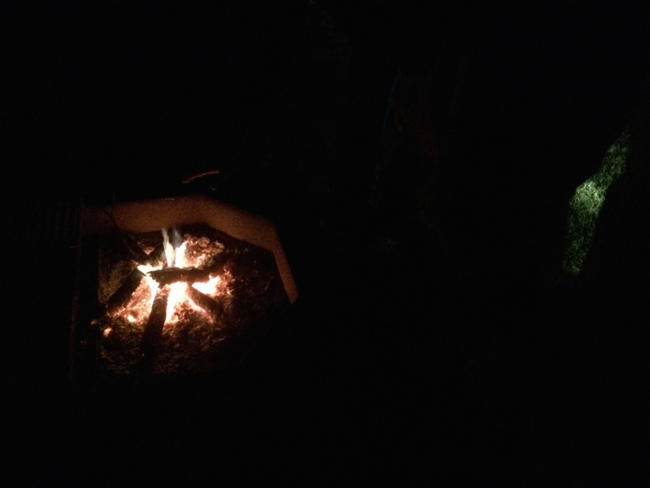
2014august18_greenlakes_fire

Old and new light – the end of the fire pit and inspecting flashlights.

With everyone departing soon after, we were left to take in a bit of the remaining fire in the pit (and our observing attire left to take in that burning wood smell) before giving the grounds one last scan with a bright flashlight before departing. A lousy evening turned into a fantastic (and slightly shortened) night for a Public Viewing Session. Kudos as always to Attilla Danko for his ever prescient Clear Sky Clock!

CNYO Observing Log: Baltimore Woods, 22 March 2014 (And An Erigone Summary)

Greetings fellow astrophiles!

The often-announced (on this site, anyway) Regulus occultation by asteroid (163) Erigone on the morning of March 20th was a near-wash (no rain, but plenty of cloud cover), with only a few messages being passed around at midnight to see if anyone was even going to try for 2:00 a.m. That said, the International Occultation Timing Association (IOTA) got lots of good press and, with luck, a similarly notable occultation will occur to catch other eyes and instigate the IOTA to prep another big public recording effort. Those who want to relive the non-event can watch the Slooh Community Observatory coverage in the youtube video below.

Then, two days later, Bob Piekiel with his Meade C11 and I with my New Moon Telescope 12.5″ Dob treated two couples at Baltimore Woods to the kind of crystal clear and steady skies you read out but usually never have the good fortune to be out for. With the late March and early April temperatures beginning to melt the high hills of ice and snow around all the big parking lots in the area, the Baltimore Woods setup was a bit solid, a bit slushy, and quite dirty. Our four-person audience arrived early in time to watch the clear skies darken and Jupiter, Sirius, and Betelgeuse first appear in the South/Southwest sky. For the next 90 minutes or so, the observing list included Jupiter (several times at several magnifications, both early in the evening and after the skies had sufficiently darkened to bring out more detail), the Pleiades (M45), the Beehive Cluster (M44), the Orion Nebula (M42), Alcor and Mizar in the handle of the Big Dipper, the Andromeda Galaxy (M31) and its prominent satellites (M32 and M110) very low on the horizon (very likely our last catches of our sister galaxy for several months to come), and even M82 to say that we had, at least, seen the location of the recent supernova (if not a last few photons from it).

In an attempt to help someone remember as many constellations as possible at the Liverpool Public Library lecture a few weeks prior, I retold one of the more memorable tales of the winter star groupings of Orion the Hunter, Taurus the Bull, Canis Major (the big dog), Canis Minor (the little dog), and the Pleiades that I picked up from the excellent Dover book Star Lore: Myths, Legends, and Facts by William Tyler Olcott (which you can even read and download for free in an earlier form at archive.org).

Long story short, the Pleiades (also known as the Seven Sisters or the Seven Virgins) were the target of Orion’s rather significant attention, so much so that in his last run to them, the ever-invasive Zeus placed an equally significant bull in Orion’s path, leaving Orion and his two dogs (Canis Major and Canis Minor) stuck in their tracks. As is apparent from the images below, these four constellations (and one star cluster/Messier Object) are all tightly spaced in the Winter Sky. Better still, the end of Winter even finds these constellations standing on the horizon (instead of upside down in morning Autumn skies), making the picture all the more easily seen. As Orion is second only to the Big Dipper in terms of ease-of-seeing by practically everyone (raised in the tradition of Western Constellation arrangements, anyway), it’s the start constellation from which to find the other three. Canis Major is easily found by its shoulder star Sirius, the brightest start in our nighttime sky. Canis Minor is a leap from Sirius to Procyon, also a prominent star. Taurus the Bull is easily found by its head, the local star cluster known as the Hyades, and its orange-red eye, Aldebaran. The small sisters lie within the boundary of Taurus in a cluster that to the slightly near-sighted might just look like a fuzzy patch (but which, in binoculars, reveals numerous tightly-packed stars).

2014march22_constellations

Our cast of characters (and nearest neighbors). Image made with Starry Night Pro.

2014march22_stars

The prominent stars in their starring roles. Image made with Starry Night Pro.

After packing up around 9:30 (about when the temperatures began to drop precipitously), I managed a single long-exposure image with my Canon T3i of the region above – quite possibly my last good look at the most famous Winter grouping until they appear again in the morning Autumn skies.

2014march29_starringroles

Final scene from Baltimore Woods (with story labels). Click for a larger view.

CNYO Observers Log: International Observe The Moon Night At Westhill School District, 12 October 2013

Greetings fellow astrophiles!

Larry Slosberg and Ryan Goodson took their New Moon Telescopes on the road to the Westhill School District for the October 12th International Observe The Moon Night (IOMN, facebook, twitter). With a fistful of our A Guide For Lunar Observing brochures in tow, both report that the near-or-exceeding 100 attendees were full of great questions and enjoyed close-up views of our nearest natural satellite.

CNYO was delighted to be a part of this local IOMN activity and strongly encourage other schools and local groups to do the same. The Moon is the easiest observing target we have, good at all magnifications (including no magnification) and all times of year. It has been a test for physical theories, the guide for calendars throughout human history, unwitting recipient of meteor impacts (still!) that might have made random Tuesdays quite hectic on Earth, muse of artists and musicians alike, and all the light needed for many a midnight hike. If you missed the “official” IOMN session, grab a pair of binos soon and give the Moon a gander!

Below are a collection of images from Larry Slosberg’s observing station (and one great image of the Moon), courtesy of Michelle Marzynski. Click on any image for the full-size version.

2013september27_iomn_1_small
2013september27_iomn_2_small
 
2013september27_iomn_3_small
2013september27_iomn_4_small
 
2013september27_iomn_5_small
2013september27_iomn_6_small
 
2013september27_iomn_7_small
2013september27_iomn_8_small
 

While Larry kept the festivities mostly Moon-centric at his scope, Ryan reports having put many of the best objects in the mid-autumn night sky on full display, including The Andromeda Galaxy (M31), the globular cluster M13 in Hercules, the double stars Albireo (a colored pair in Cygnus) and Mizar/Alcor (a double that becomes a triple at moderate magnification in Ursa Major), the open cluster M39 (“everyone’s fave it seemed” – L.S.) in Cygnus, and finally the Ring Nebula (M57) and the Double-Double in Lyra.

For myself, I celebrated IOMN early from the comfort of a window seat at 36,000 ft. With luck, I hope to be on the ground and running yet another scope for next year’s IOMN session!

2013september27_iomn_9

CNYO Observing Log: Baltimore Woods, 27 September 2013

Greetings fellow astrophiles!

The September 27th Baltimore Woods session was notable for several reasons. On the down side, my drive to Marcellus through Fairmount was delayed when a minivan with far too many large dogs in it had one of its automatic windows dropped down to the delight of an ejected dog that bounced off my driver side door (my non-astro thought for the day – if your pets are your children, please use the child safety options built into your very modern vehicle!). On the up side, for the first time since March, a Baltimore Woods session started at 7 p.m. The skies were dark enough to begin seeing the brightest stars with ease and cold enough to freeze out the many bugs that frequent the BW Nature Center.

Attending scopes included Bob Piekiel‘s massive 16″ Meade GOTO (with some included heavy lifting by the two of us to get it set up and torn down), Larry Slosberg’s 12″ New Moon Telescope, and my 12.5″ NMT Dob (herein referred to as “Ruby”). A fourth scope appeared early in the evening with the first attending family, but ended up not getting too much use. Despite being a bit worse for wear, their “retail store” Stratus 60mm refractor scope surprised the owners (and kids) with a good view of a distant cellular tower and a fuzzy but noticeably “half-moon cookie” Venus (whatever description works is fine with me).

2013september27_bw_bobstratus

Bob inspecting the Stratus 60mm.

The final size (25ish) of the crowd (and the number of first-time attendees) dictated the observables for the evening, with all of us sticking mostly to bright, easily identifiable objects. As for our local neighborhood, the good news was that more than half of the planets were out for the evening (counting the views of Earth). The bad news was that Venus and Saturn set early (both due to the time and the high trees along the Western horizon), leaving the very distant Uranus and Neptune as targets for later-night observers.

As has been my standard procedure, I picked one object from my standard list of “kinds of” objects so those at my scope would be sure to get a sampling of the types of objects we amateur astronomers look forward to looking at. My list included:

* (Hopefully) One Planet – From my (scope’s) vantage point, Venus and Saturn were impossible catches behind large trees. Neptune and Uranus were, for the entire viewing session, nestled within the glow of Marcellus (and Syracuse beyond), so I didn’t even bother attempting to find them. Bob, however, had at his disposal a massive GOTO, so the gathered crowd was able to take in at least one of the two distant planets (making them part of the way-less-than-1% of the entire planet who can claim the same).

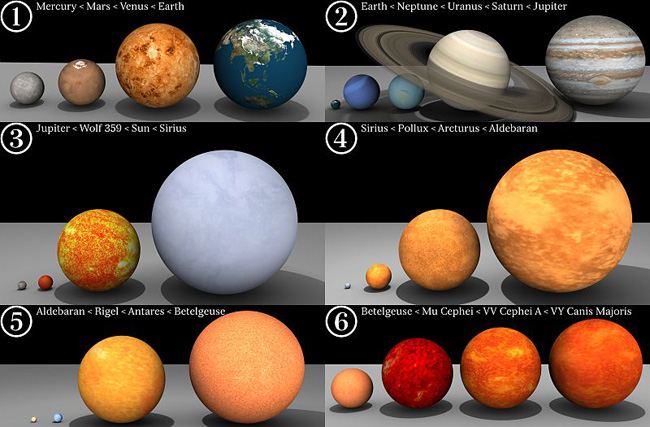
* One Star – At Bob’s request, I gave special attention to Herschel’s Garnet Star (mu Cephei) in Cepheus. One of the real benefits of magnification through good optics (or long-exposure photography) is the appearance of color in many stars that are otherwise just too slightly colored to be noticeable to Naked Eye observers. While the different colors of the binary star Albireo are generally obvious to most people, the Garnet Star jumped out to everyone through every eyepiece as a very orange star. This red supergiant, affectionately known to some as Erakis, is BIG. Those who have seen the image below in one of our CNYO library lectures…

2013september27_bw_starsizes

The scale of familiar objects in our vicinity (click for the wikipedia version).

Will recognize Mu Cephei as the third star from right (in the “Big Block” 6) in the bottom of the image. Our own Sun peters out in Block 3. If a super race of aliens were to swap out our Sun for the Garnet Star, the outer edge of its plasma would engulf Jupiter and either engulf or roast Saturn. Big. Not only big, but old to boot. Mu Cephei is what is known as a “carbon star,” one that has nearly exhausted its helium (which is produced from all the fusion of hydrogen, which it then exhausted quite some time ago) and is now producing carbon in the star’s core. The near-exhaustion of the star’s fuel means that it’s likely only a few million years from going supernova (somewhere between a finger snap and ringing wine glass in cosmic terms) and is currently identified as a variable star for its subtle and erratically changing brightness.

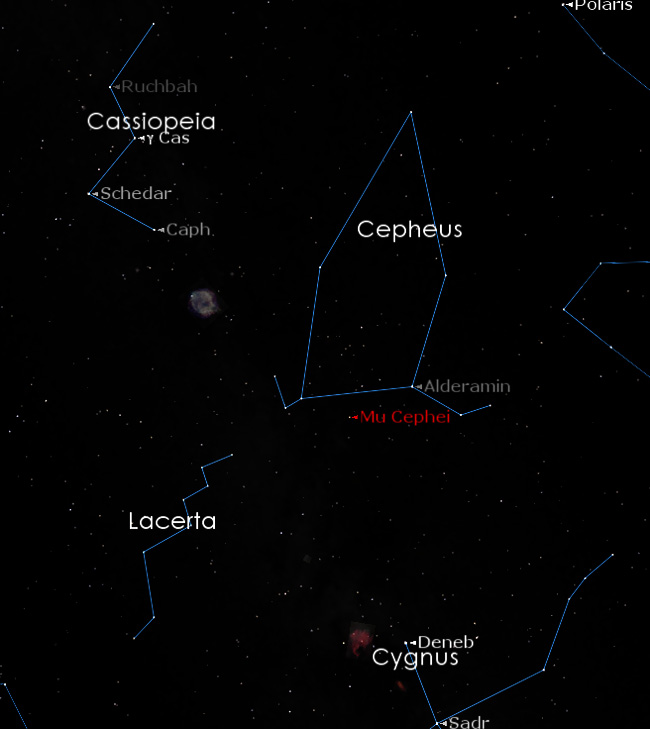
2013september27_bw_cepheus

Mu Cephei, Cepheus, and surrounding constellations.

As you scour Cepheus some evening, do take the Garnet Star in. If you’re scanning randomly along the bottom of the barn, you can’t miss it!

* One Binary – Albireo in Cygnus remains an easy favorite. Everyone saw Albireo A as slightly orange or yellow, while Albireo B appeared as slightly to “clearly” blue (clearly a demonstration of the importance of dark adaption and cone sensitivity in the retina). One point of interest is that we’re not entirely sure of Albireo is an optical binary (the two just appear close, but one is much farther away than the other as projected onto our two-dimensional sheet of the Night Sky) or a gravitationally-bound binary pair. If gravitationally-bound, the two are likely far from one another, with the orbital dance occurring over 100,000 or more years.

* One Open Cluster – The Double Cluster (Caldwell 14) in Perseus

* One Globular Cluster – The ever-obvious M13 in Hercules

* One Nebula – The Veil Nebula in Cygnus – typically, this would be considered one of the less-easy objects for a new observer to make out. Through an OII filter, however, the wispy-ness jumps out and new observers, with a little patience, can even see the curvature of each fragment well enough to know where the Veil must be radiating from.

* One Galaxy – M31, The Andromeda Galaxy in Andromeda (and M32 and M110), which were easy for all to spot with a little scope nudging.

As has become the norm recently, I packed up Ruby around 9:30 p.m. and pulled out the Canon T3i and tripod for an extended session of scope-less astrophotography. Three highlights include a very discernible Milky Way, complete with Great Rift, from opposite the direction of Marcellus…

2013september27_bw_mw_1_small

The Milky Way (plus one bright plane and one dim satellite). Click for a larger version.

A dimmer part of the Milky Way that seemed to radiate from (and be washed out by) Marcellus…

2013september27_bw_mw_2_small

The Milky Way and Marcellus (plus a dim plane (dashed line) and dim satellite). Click for a larger version.

And a quite decent view of the varied objects in the vicinity of the constellation Perseus (in the pocket between the two trees and closer to the left tree), including the components of the Double Cluster, NGC 884 and 869 (the fuzzy splotches at the base of the small necklace – 1/3 over from the left edge and 1/4 down the image).

2013september27_bw_perseus_full

Perseus, NGC 884, and NGC 869. Click for a larger version.

I packed it in around 10:00 p.m. in great anticipation! Within the glow of Marcellus lay the Pleiades (M45) and just a hint of its closer cousin the Hyades in the head of Taurus the Bull. These objects have likely served as markers for many millennia that the clear, dark, steady, and uncomfortably cold night skies of winter approach.