Tag Archives: Ursa Major

CNYO Observers Log: MOST Climate Day And North Sportsman’s Club Practice Session, 19 April 2014

Greetings fellow astrophiles!

The Saturday after NEAF was a busy one for CNYO members, including a lecture and observing session for the MOST Climate Day during the afternoon and a nighttime “dry run” for the North Sportman’s Club Public Viewing Sessions we’re on the verge of hosting for the rest of the year.

The morning started with a hectic rearrangement of speakers for the TACNY Jr. Cafe session, with Prof. Peter Plumley (MOST, Syracuse University) and Prof. Timothy Volk (SUNY-ESF) admirably filling in for a missing speaker (and the crowd requests for future topics were heavy in astronomy!). And speaking of Jr. Cafe astronomy, we note the May 17th lecture features CNYO’s own Ryan Goodson speaking on Newtonian Telescopes (with a solar session to follow if the skies hold)!

The indoor part of CNYO’s contribution to the MOST Climate Day featured myself and a lecture about the Sun/Earth relationship. While that lecture was given to only 2.5 people (one person left half-way), a 50 minute talk extended to 90 minutes thanks to some excellent discussions and deeper probing of some of the slide content.

2014may8_nsc_larry_small

Larry and observers on the Creekwalk. Click for a larger view.

Outside, Larry Slosberg hit the public observing jackpot with his 12″ Baader-ized New Moon Telescope Dob and NASA Night Sky Network Solar Kit. Between the MOST crowd, Record Store Day at Sound Garden, and a Creekwalk made busy by the clear skies and comfortable temperatures, Larry counted over a few dozen new observers before I even made it outside. To Larry’s solar collection I added a Coronado PST for some excellent H-alpha views of sunspots and several prominences that changed significantly over the course of an hour (which was made all the more impressive to passers-by when you mention that these changes could be measured in units of “Earths” instead of miles).

2014may8_nsc_solar_small

An intrepid observer at the Coronado PST. Click for a larger view.

Larry and I packed up around 4:00 p.m. after giving nearly 40 people a unique view of our nearest star, providing a three-hour window before heading off to North Sportsman’s Club (NSC) for an evening session.

2014may8_nsc_crew_small

Some of the NSC crew setting up. Click for a larger view.

We also used April 19th as a reintroduction to the skies above the NSC, with this session opened up to a short-list of people with scopes interested in helping reduce the lengths of observing lines at future public sessions (and we welcome others interested in bringing their scopes to these sessions to please contact us using our online form or by emailing us at info@cnyo.org).

2014may8_nsc_bigdipper_small

The Big Dipper (Ursa Major) and surroundings. Click for a larger view.

The total in attendance was between 10 and 12 over the two hours I was present (and the event continued for some time after), with about half as many scopes present (which is a great number for even large public viewing sessions). Despite it becoming a very cold evening, the combined observing list was extensive from among all parties, with New Moon Telescope’s 27″ Dob making many views extra memorable.

2014may8_nsc_southwest_small

The view to the Southwest (featuring a bright Jupiter near center). Click for a larger view.

We are planning our first public session for 2014 in late May, perhaps to coincide with the predicted meteor super-storm on the early morning of May 24th. Keep track of cnyo.org or our Facebook group page for details!

CNYO Observers Log: International Observe The Moon Night At Westhill School District, 12 October 2013

Greetings fellow astrophiles!

Larry Slosberg and Ryan Goodson took their New Moon Telescopes on the road to the Westhill School District for the October 12th International Observe The Moon Night (IOMN, facebook, twitter). With a fistful of our A Guide For Lunar Observing brochures in tow, both report that the near-or-exceeding 100 attendees were full of great questions and enjoyed close-up views of our nearest natural satellite.

CNYO was delighted to be a part of this local IOMN activity and strongly encourage other schools and local groups to do the same. The Moon is the easiest observing target we have, good at all magnifications (including no magnification) and all times of year. It has been a test for physical theories, the guide for calendars throughout human history, unwitting recipient of meteor impacts (still!) that might have made random Tuesdays quite hectic on Earth, muse of artists and musicians alike, and all the light needed for many a midnight hike. If you missed the “official” IOMN session, grab a pair of binos soon and give the Moon a gander!

Below are a collection of images from Larry Slosberg’s observing station (and one great image of the Moon), courtesy of Michelle Marzynski. Click on any image for the full-size version.

2013september27_iomn_1_small
2013september27_iomn_2_small
 
2013september27_iomn_3_small
2013september27_iomn_4_small
 
2013september27_iomn_5_small
2013september27_iomn_6_small
 
2013september27_iomn_7_small
2013september27_iomn_8_small
 

While Larry kept the festivities mostly Moon-centric at his scope, Ryan reports having put many of the best objects in the mid-autumn night sky on full display, including The Andromeda Galaxy (M31), the globular cluster M13 in Hercules, the double stars Albireo (a colored pair in Cygnus) and Mizar/Alcor (a double that becomes a triple at moderate magnification in Ursa Major), the open cluster M39 (“everyone’s fave it seemed” – L.S.) in Cygnus, and finally the Ring Nebula (M57) and the Double-Double in Lyra.

For myself, I celebrated IOMN early from the comfort of a window seat at 36,000 ft. With luck, I hope to be on the ground and running yet another scope for next year’s IOMN session!

2013september27_iomn_9

CNYO Observing Log: Baltimore Woods, 5 April 2013

2013april8_baltimorewoodsbanner_v2

Bob Piekiel’s monthly session at Baltimore Woods featured crystal clear skies, increasingly cold conditions (a recurring theme this year for all of the previous sessions), and one large scope.

This Baltimore Woods session was the last scheduled event before our Winter constellations all-but disappear from our nighttime skies. To this pressing deadline was added the last reasonable observation of Comet panSTARRS (C/2011 L4) from the same location, as the return of the foliage through May will all-but obscure the parts of the North/NorthWest horizon that are not already obscured by naked branches. The event itself was scheduled from 7:30 to 9:30 p.m., ending an hour before any first observation of Saturn for the evening. The ever-dropping temperature that evening found us ending the session promptly to the sound of running (with heat on full-blast) cars and depleted propane.

2013april8_baltimorewoods1

Bob Piekiel and the author post-assembly.

With a confirmed heavy lifter attending (me), Bob opted to bring out a 16” Meade SCT on a homemade tripod that is (minus the scope) transported in the open – the whole considerable contraption hitches to the back of the car. After a bit of heavy lifting and careful coordination to get the scope up to the mount, the completed assembly was ready for the first signs of bright stars (in this case, Sirius and Capella) to perform the alignment. The time waiting for bright star arrivals was passed with the help of a pair of Zhumell 25×100’s that saw (1) clear views of Jupiter and all four of its largest moons and (2) Sirius in Canis Major to the West.

2013april8_baltimorewoods4

Bob Piekiel putting the finishing touches on a 16″ Meade SCT.

The height of the tripod combined with the extra 8” of wheels on the mount’s base meant that a step ladder was required for nearly all viewing throughout the night. With the 16” SCT aligned, the first official view (pre-dark sky) was of Jupiter, which was bright and clear in Bob’s 40 mm Meade eyepiece. The second object was Trapezium in the Orion Nebula (M42), which was also crisp and clear despite our observing it only minutes after sunset.

The third object observed combined low brightness with near-horizon position just past dusk. Bob managed to find Comet panSTARRS almost due North of the Andromeda Galaxy just as it was about to hit the bare tree line. The view was excellent for several minutes as everyone had a few looks at this increasingly difficult-to-observe object (comet’s center was reasonably well defined, but this was a 16” scope with a 40 mm eyepiece). And, it should be noted, the object database in Bob’s GOTO computer is not only older than the discovery of Comet pan-STARRS, but also quite a bit older (decade? maybe two?) than the Panoramic Survey Telescope and Rapid Response System (Pan-STARRS) that originally identified the comet. So, extra kudos to Bob for the timely find!

The cold set in quickly after these first three objects, meaning the last four objects for the evening were approached with haste. In a return to the objects of his last session, Bob treated attendees to excellent dark views of M65 and M66 in Leo, M108 (a faint edge-on galaxy near the Owl Nebula in Ursa Major that was as bright in the 16” as it was with Bob’s 11” scope + image enhancer), and the Owl Nebula (M97). Bob and I saw this final object as a confirmation that it hadn’t flown the coop during our last session, where the image enhancer failed to produce any particular view of this object (see the last session notes for details).

2013april8_baltimorewoods2

New supernova in M65. Photo by Felipe Pena.

NOTE: I wish I had known earlier that a new supernova was discovered in M65! As a general point of reference, those looking for the most complete and up-to-date information about supernovas are directed to David Bishop’s excellent Bright Supernova database and log at www.rochesterastronomy.org/supernova.html. Details and many, many images of the new supernova in M65 can be found at: www.rochesterastronomy.org/sn2013/sn2013am.html

The totality of views through the Zhumell 25×100’s were limited to Jupiter (as a sampling for the attendees before the 16″ was properly GOTO’ed), Sirius (just to the left of Orion and the brightest star in our Night Sky), the Double Cluster in Perseus (bright and densely packed), and the Pleiades (M45), the object for which I assume 25×100’s were originally designed to observe (near-perfect fit of the whole cluster in the field of view).

A few street lights and distant clouds to the East reflecting Syracuse back down provided all the illumination that the stars didn’t as we began to pack up the gear at 9:30 p.m.

And did the 3rd Quarter Moon affect the viewing? For those observing at “reasonable” hours, it is the case that the 3rd Quarter Moon doesn’t rise until midnight, meaning the week before a Full Moon, the week of a Full Moon, the few days before a 1st Quarter are excellent for getting outside to observe deep sky objects at “reasonable” hours (reasonable being relative, of course).

2013april8_baltimorewoods3

Not a lunar landing scene. Mid-way through the 9:30 pack-up.

Next session is scheduled for May 4 (Saturday) – 5 (Sunday), 8-10 p.m. and will feature Jupiter, Saturn, and hopefully a few shooting stars from the Eta Aquariids meteor shower. For details and registration, see the details on this CNYO page.

CNYO Observing Log: Baltimore Woods, 16 March 2013

2013march16_baltimorewoodsbanner_v2

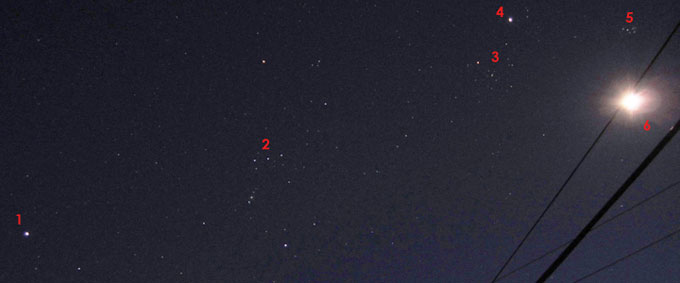
ABOVE: A 15 sec. exposure from Baltimore Woods. (1) Sirius in Canis Major, (2) Orion, (3) The Hyades (the head of Taurus the Bull), (4) Jupiter, (5) the Pleiades, (6) The Moon.

The sky opened up for a crisp and clear viewing session late in the day after a long spell of heavy cloud cover on Saturday, March 16th. I made it to Baltimore Woods just in time for Bob Piekiel to direct me and my pair of Zhumell 25×100’s to the low-Western Horizon to take in Comet pan-STARRS (C/2011 L4, that is) with a light amber coloring and even a slight vertically-pointing oval that became an obvious tail at low magnification. This view only seemed to get better Sunday night (17th), where the comet was Naked Eye from downtown Syracuse!

A horizon view of pan-STARRS is shown below (above the red asterisk. Canon DS1400 IS Digital Elph, 15 second exposures). Click on the image for a larger view.

2013march16_baltimorewoods_2

A time lapse of pan-STARRS setting below the Western horizon at Baltimore Woods is shown below (starts below the asterisk at left. Canon DS1400 IS Digital Elph, 4x zoom, 15 second exposures). Click on the image for a larger view.

2013march16_baltimorewoods_2

A view through the Zhumell 25×100 binos is below (by way of some fancy camera balancing). Click on the image for a larger view.

2013march16_baltimorewoods_2

spaceweather.com has a summary of the current situation on their website (as of 19 March 2013):

A growing number of people are reporting that they can see Comet Pan-STARRS with the naked eye. Best estimates place the magnitude of the comet at +0.2, about twice as bright as a 1st magnitude star. As the comet moves away from the sun, its visibility is improving. Observing tip: Step outside about an hour after sunset and face west. Pinpoint the comet using binoculars. Once you know where to look, put the optics aside and try some naked-eye observing.

By the time pan-STARRS set below the horizon, the sky was quite dark and extremely transparent. Bob and I proceeded to play for an hour with his 11” SCT, new Meade 5000 super- and ultra- wides (24 mm and 40 mm), and my personal favorite, his Collins Image Intensifier (which does exactly what it describes – increasing the brightness of objects in the eyepiece and, in many cases, making observable a dim object you might otherwise completely pass over without knowing it was there – you can see some example images here: darkerview.com/wordpress/?tag=intensifier).

Besides a thoroughly enjoyable conversation about optics, focal reducers, and new eye candy to look for at NEAF, highlights of the observing session included:

Visible Planets

* Jupiter (just to the right of the Hyades, as Taurus exchanges its otherwise brightest left eye (Aldebaran) with Jupiter as its right eye). Having given Jupiter considerable scope time this year already, we checked it mostly just to confirm it was still there.

In Taurus

* Messier 45 – The Pleiades served as an excellent cluster for testing Bob’s new focal reducer (which, basically, increases the field of view). An excellent image showing what the focal reducer does is shown below (from webcaddy.com.au/astro/f-066fr-pics.htm).

2013march19_focalreducer

In Orion

* Messier 42 – The Orion Nebula (without and without enhancement, with the Collins brightening and increasing the extent of the nebulosity). The Orion Nebula is the brightest and most expansive nebula observable from Earth and it sets earlier every day, so we spent considerable time on it before missing it all Spring and Summer.

In Andromeda

* The Andromeda Galaxy (M31) and Messier 32 – The intensifier brought out the presence of the central core of Andromeda but did not significantly enhance detail (specifically the dust lanes and spaces between the spiral arms that one can see in any eyepiece in dark skies). This was likely due to the presence of the Moon nearby in the sky (which can do a significant number to nebula and galaxy detail even when only present as a sliver), but I did learn some more about the intensifier eyepiece (see below). M32 (one of M31’s satellite galaxies) was also bright but featureless.

In Leo

* Messier 65, Messier 66, and NGC 3628 – All three galaxies in The Leo Triplet were excellent in the intensifier (and in the same field of view) despite the Moon. At the first Inner Harbor session, M65 and M66 were just visible (due to the the light pollution around the site) thanks to Ryan Goodson bringing a 16” New Moon Telescope Dobsonian.

In Gemini

* Messier 35 – an open cluster nearly the size of the full Moon, containing a few bright stars and a tight grouping of dimmer ones. The intensifier has a tendency to “haze” a bit around these tight groupings as the pixels on the CCD chip begin to oversaturate.

In Canis Major

* Messier 41 – While observing this open cluster, the over-saturation of the CCD chip became obvious in the form of perfectly circular discs around each of the brightest stars, making each appear to have a well-defined nebula around it (not that these stars need any kind of image enhancement to see clearly in any scope. As you might guess, brighter star = bigger + brighter disc).

In Perseus

Caldwell 14 – The Double Cluster – in the same way that stereotypical night vision goggles give you only shades (or different intensities) of green, the intensifier sacrifices color for “green intensity.” Accordingly, the reds, oranges, and blues in the Double Cluster that make it such an interesting eyepiece object go away, leaving you with just (well, not just) two dense star clusters. This is the best argument for intensifiers being used as tools for galaxy and nebulae hunting.

In Ursa Major

Messier 81 – NGC 3031, Bode’s Galaxy – An excellent sight in the intensifier despite the crescent Moon (which would otherwise make it nearly featureless).

Messier 82 – NGC 3034, Cigar Galaxy – M81’s gravitational neighbor (with M82 being the smaller neighbor and, therefore, more gravitationally influenced by M81). M82 appears to have two distinct cores in the intensifier (that would make it look like two galaxies about to merge). I attribute this double-core view to the intensifier picking up the massive filamentous structure perpendicular to M82’s galactic plane – but should buy my own intensifier to study it in more detail!).

Messier 97 (Own Nebula) + Messier 108 – Admittedly, Bob and I kept passing M108 while trying to find M97 and failed to recognize it as M108 (faint but pleasant in the intensifier). That said, M97 was a very difficult find despite Bob bringing a GOTO scope and, by the time I confirmed to myself that I had it in the field of view, I was under-impressed with the intensifier view (it was barely an object with averted vision, although some part of this could have been the Moon’s presence).

We closed the session around 9:15 p.m. by returning to the Orion Nebula for one last comparison of the intensifier and the Meade 40 mm.

Lessons for the evening: (1) Don’t assume of comets! And, if you observe, report to the group so others know to also not assume! (2) Just because you’re freezing cold doesn’t mean you should stand 1/2 inch from a portable propane heater. At what feels like cryogenic temperatures, your leg goes from 10 F to 150 F before your nerves notice it.